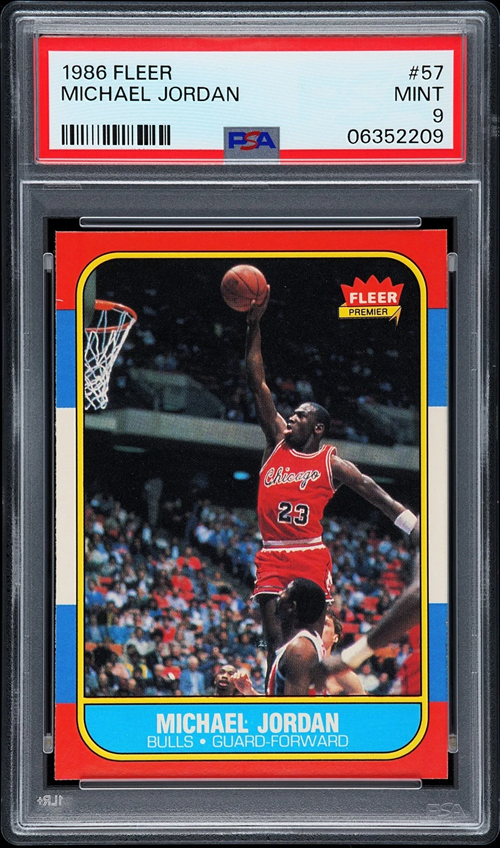
If you collect sports cards, you probably know the most famous basketball card ever made, the 1986-87 Fleer Michael Jordan #57.
It’s Michael Jordan’s rookie card. Except there’s one small problem. It isn’t actually from his rookie season, nor is it his first licensed NBA trading card.
Jordan’s NBA rookie season was 1984-85, when he averaged 28.2 points per game, made the All-Star team, and won Rookie of the Year. And there actually was a licensed Michael Jordan basketball card released that season, the 1984-85 Star Michael Jordan #101.
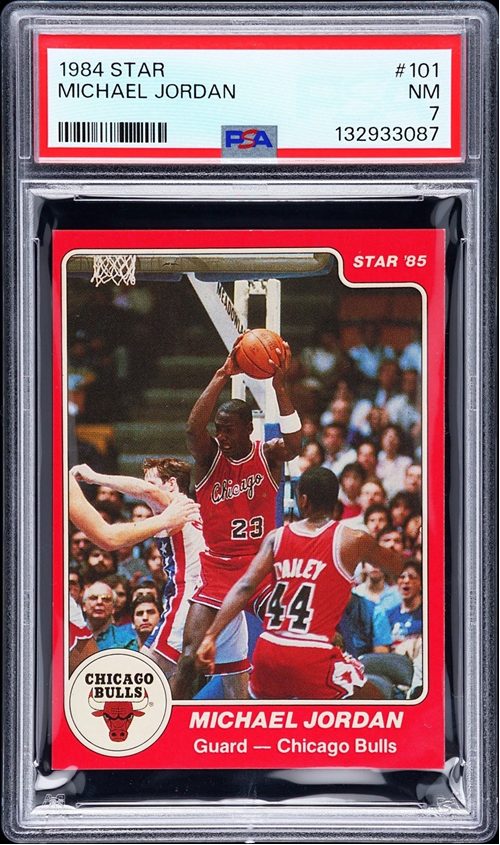
Why isn’t the 1984-85 Star considered Michael Jordan’s rookie card?
At the time, Star Company had the NBA license and produced team sets featuring NBA players. The 1984-85 Star set included Jordan #101 in his rookie season uniform. It wasn’t some oddball unlicensed card or something produced years later and backdated. It was a legitimate, NBA-licensed basketball card.
The problem was how Star distributed its cards.
Unlike most trading cards, Star cards weren’t sold in wax packs at your 7-11 or Circle K store. They were primarily distributed as bagged team sets through hobby dealers and distributors.
That distinction became important to the hobby.
For years, publications such as Beckett classified the 1984-85 Star Jordan as an XRC, or “extended rookie card,” rather than a traditional rookie card. The 1986-87 Fleer Jordan, meanwhile, received the coveted RC designation because it came from a traditionally distributed, nationally released pack-based set.
And that’s how we ended up in the bizarre situation we’re still in today.
Jordan’s 1984-85 Star #101 was released during his first NBA season. Star released another Jordan card, #117, during his second NBA season in 1985-86. Then Fleer released Jordan #57 during his third NBA season in 1986-87.
I understand why the hobby arrived at that conclusion. Trading card terminology has always depended on more than simply the year printed on the card. Distribution, licensing, set structure and hobby conventions all matter.
If an officially licensed Michael Jordan card was released as part of a regular basketball set while Michael Jordan was actually an NBA rookie, I’m perfectly comfortable calling it a rookie card.
In fact, I’d argue the 1984-85 Star #101 has a better claim to being Jordan’s true rookie card than the Fleer.
Why the 1986-87 Fleer will always be considered Michael Jordan’s true rookie card
None of this detracts from the 1986-87 Fleer Jordan. It’s an iconic card. It’s arguably the iconic basketball card. Generations of collectors have recognized it as Jordan’s rookie, and that isn’t going to suddenly disappear.
But an iconic rookie card and the first licensed card from a player’s rookie season aren’t necessarily the same thing.
In Michael Jordan’s case, they’re separated by two years.
The 1986-87 Fleer #57 will forever be known as the Michael Jordan rookie card. That’s because there’s too much money in the 1986-87 Fleer Jordan card for it ever to be considered his third-year card, even though it is.
As of today, there have been a total of 28,069 Fleer Michael Jordan rookie cards graded with PSA. With that much money, a person could buy three Pakistani nuclear weapons on the black market and have enough money left over to purchase an island fortress.
Trust me. I’ve looked into it.
In comparison, a total of 569 Star Michael Jordan rookie cards have been graded by PSA.
In conclusion
The sports card collecting hobby has spoken with their wallets. The 1986-87 Fleer Michael Jordan card is the rookie card. There’s far too much wealth tied to the card to think anything else.